


July 2026
Tackling Climate Change: Small Lifestyle Changes with Big Impact
53% of Irish people are concerned about the impact climate change will have on their local community.
We’re hearing a lot about the climate crisis in recent years and the facts are plain to see. The last eight years have been the hottest on record and research has shown that global temperatures are warming at a trajectory which is no longer sustainable for the environment to survive¹.
The Irish Climate Outlook: Why Local Action Matters
We partnered with the Journal.ie for our Securing Your Future survey series* and found that over half of Irish people are concerned about what the impact climate change will have on their local area. With that in mind, we put together some simple ways to live more sustainably, which are not only good for the environment but can be good for your bank account too!
The Securing Your Future survey series results suggest that concern about the effects of climate change on local areas is a more pressing issue for younger generations. Among those surveyed, 6 out of ten aged between 18 and 44 said they were concerned about the potential impact of climate change on their local area.
We’ve all heard of the targets placed on Ireland and other countries in order to tackle the climate crisis. But while it’s important that governments take action – and the public continues to pressure governments for action – experts have said there’s still a lot that individuals can do to counter climate change. Research has shown that lifestyle changes could play a key role in helping the planet slash emissions by up to 70% by 2050².
That’s why we’ve put together this guide to being more eco-friendly in different parts of our lives. We want to highlight the personal changes that you can make to contribute towards system change and improve your local community.
Sustainable Homes: Energy-Saving Wins and Green Building Grants
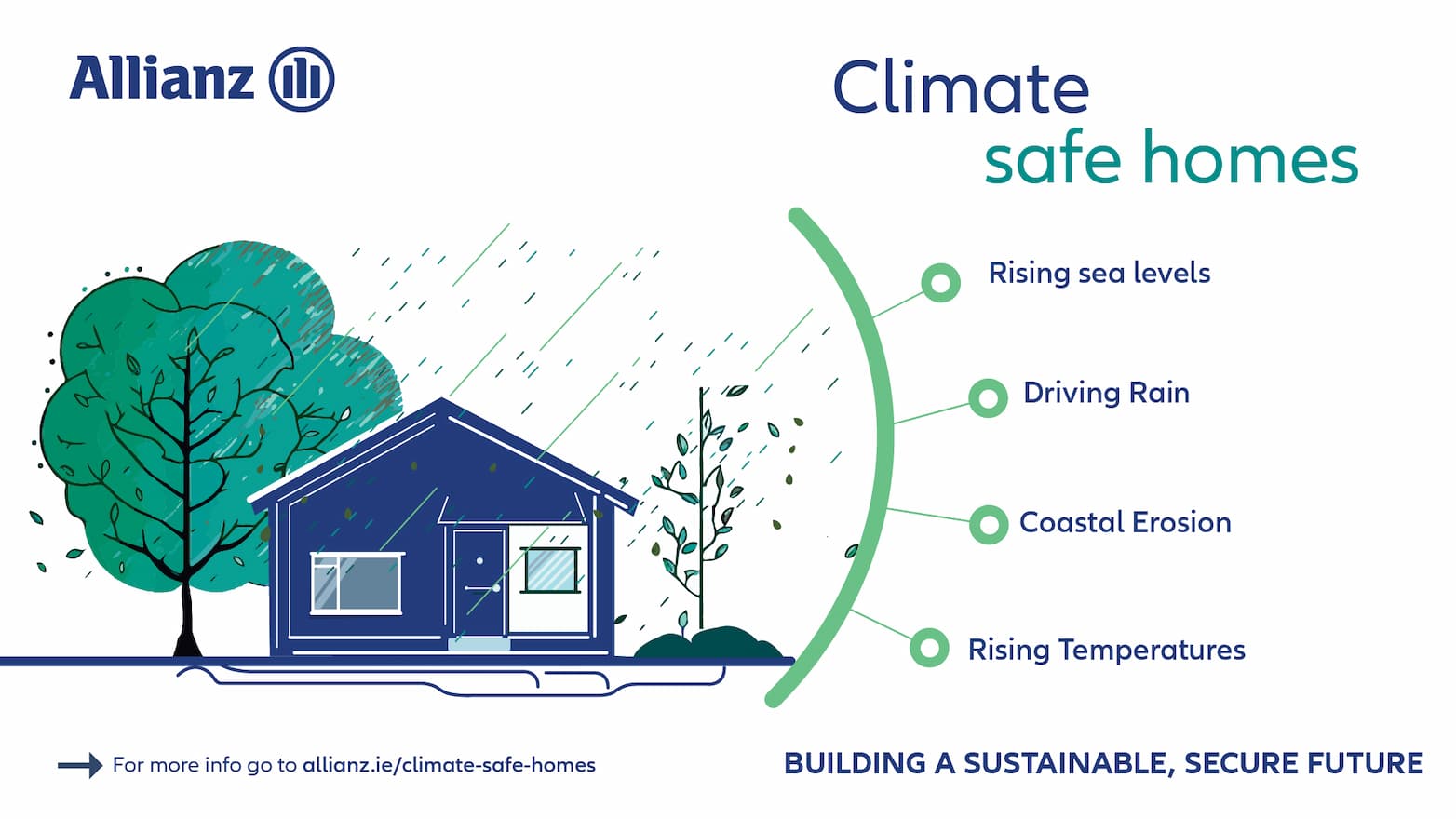
Homes and businesses across Ireland are making efforts to make their practices more sustainable and prepare for changes to climate in the future. Indeed, 29% of respondents to our survey said they believed that climate change would impact their home directly.
To address concerns such as these, we at Allianz have launched ‘Climate Safe Homes’, an initiative where we bring together key stakeholders across construction, engineering, and architecture to pioneer and develop a new home building model designed specifically to withstand the effects of Ireland’s changing climate. Climate Safe Homes intends to accelerate climate adaptive home building in Ireland and will focus on future proofing newly built homes while also identifying ways to retrofit our existing homes to ensure they can withstand climate change.
As a leading insurer of Irish homes and business, this initiative forms just one part of our wider sustainability commitements.
When it comes to our own home, 1 in 4 respondents to our Securing Your Future survey series said they didn’t know or were unsure of what changes they could make to run a more sustainable home. But it’s important to know there’s an opportunity for you to make some big wins right now on your quest for a more sustainable home.
Reducing the temperature on your thermostats by just one degree can help lower your heating bill by 10% and help reduce your energy use ³. Upgrading to energy-efficient LED lights is a great way to save money and energy on lighting4, compared to using older, inefficient bulbs. Limit using your dryer and use a lower temperature for your washing machine and dishwasher, as well as not using both until you have a full load. Read more about our energy saving tips.
The Government has also introduced a series of supports to help households upgrade their home energy rating. Check out Sustainable Energy Authority of Ireland (SEAI) for more information on the grants available for upgrading your home to make it more efficient and eco-friendly.
At Allianz, we recently launched Rebuild Better - a new and exclusive benefit which offers customers with eligible policies an additional €6,000 on building claims of €50,000 or more to invest in sustainable, energy-efficient upgrades to their homes as part of their reconstruction process, in addition to SEAI grants already available.
Rethinking Your Wardrobe: Moving Past Fast Fashion and Textile Waste
In Ireland, we throw away 110,000 tonnes of textiles as waste every year5, of which 42,000 tonnes are clothing. The most straightforward way to combat this waste is to not throw away clothing that is still wearable. It’s possible to make alterations to your clothing to increase their lifespan and also keep up with current trends.
If you are getting rid of clothing that still has some life in it, consider donating it to a local charity shop or clothes bank so that your pre-loved clothing has the opportunity to serve another person. Alternatively, there’s a growing online market for vintage and second hand clothing where you can advertise and sell items that you no longer need.
Try to avoid fast fashion as participating in these trend cycles has contributed to a rise in over-consumerism and an increase in clothing waste. Shopping in second hand outlets or buying vintage clothing is a more sustainable choice and also helps you to mix up your wardrobe with different items you may not have previously considered.
If you do have to buy new clothing, try to pick items which won’t shed as many microfibres when washed in your machine. Microfibres are a type of microplastic released when we wash synthetic clothing. These fibres detach from our clothes during washing and go into the wastewater, and from there the fibres are so small, many pass through filtration processes and make their way into our rivers and seas. Some of the ones to avoid if possible include polyester, acrylic, and nylon.
Conscious Eating: Reducing Food Waste and Eliminating Food Miles
In Ireland, we waste about 800,000 tonnes of food each year with household waste accounting for 29% of it6. This seems like a lot and indeed it is, but when you factor in the growing, processing and transporting of food which uses a huge amount of resources, such as land, water, energy and fertiliser, the figures are even more stark.
Households can limit their food waste by portioning meals reasonably, only buying what’s needed and using food waste as fertiliser for soil and plants.
Other ways to cut food waste include eating or giving away perishable food if you’re going on holidays. Check the date on the food in your fridge or cupboard and if you don’t think you’ll be able to eat it prior to leaving, freeze it to use at a later date, give it to a neighbour or donate it to someone in need to help cut down on food waste.
Another way to help make your food intake more sustainable is to be aware of food miles. This is the distance food travels to get to our plates. Buying from local food producers when you can is a good way to combat food miles, but it also helps to strengthen local supply chains meaning more options in the event of food supply issues. It’s also better for you nutritionally as local produce is closer to source and has spent less time being transported to your area.
*Poll conducted for Allianz & TheJournal.ie by Ireland Thinks. Date of Survey: 4th of August, 2023. Sample size: 1,272 Margin of Error: +/- 2.8 per cent.
Climate change FAQs:
Q: How can individuals contribute to tackling climate change?
A: While structural government action is vital, individual lifestyle changes play a massive role in reducing environmental impact, with potential to help cut global emissions by up to 70% by 2050. Everyday actions—such as lowering home thermostat settings by just one degree to reduce heating bills by 10%, transitioning to high-efficiency LED lighting, eliminating household food waste, and opting for pre-loved or vintage clothing instead of fast fashion—collectively drive massive systemic change.
Q: What is a climate-safe home and how can I make my house eco-friendly?
A: A climate-safe home is a property constructed or retrofitted specifically to withstand changing regional weather patterns while maintaining a low carbon footprint. Homeowners can future proof their properties by utilizing Sustainable Energy Authority of Ireland (SEAI) grants for energy efficiency upgrades. Additionally, through initiatives like Allianz's Rebuild Better benefit, qualifying insurance claimants with building damage of €50,000 or more can receive an extra €6,000 to directly fund sustainable upgrades like heat pumps or advanced wall insulation during reconstruction.
Q: How does food waste affect the environment and how can it be reduced?
A: Food waste is a primary driver of environmental strain because throwing away food also wastes the land, water, fertilizer, and transport energy used to produce it. In Ireland, households generate nearly 30% of the country's annual 800,000 tonnes of food waste. You can actively combat this by portioning meals mindfully, freezing perishable items before traveling, and prioritising local food producers to drastically cut down on "food miles"—the carbon-heavy distance food travels to reach your plate.
Home Energy Saving Tips
Explore our TikTok related videos through the links below.
Allianz p.l.c. is regulated by the Central Bank of Ireland. Standard acceptance criteria, terms & conditions apply. Information correct as of date of publish.
Information correct as at 25/07/2026
About the author
